Research
The Poudel Lab develops advanced tissue processing workflows, high-resolution 3D imaging platforms, and computational tools (which include AI-based approaches) to advance the emerging field of 3D digital pathology. With these innovative tools, our mission is to deepen the understanding, diagnosis, and treatment of disease, with the ultimate goal of improving human health.
We are deeply committed to collaborative science, working closely with bioengineers, clinical researchers, and pathologists to ensure our discoveries are both scientifically rigorous and translationally meaningful. By bridging basic research with clinical application, we strive to accelerate the development of next-generation diagnostic tools and therapeutic strategies that improve patient outcomes.
Our current projects are focused on the following themes:
(i) Building the foundation: tissue clearing and open-top lightsheet microscopy
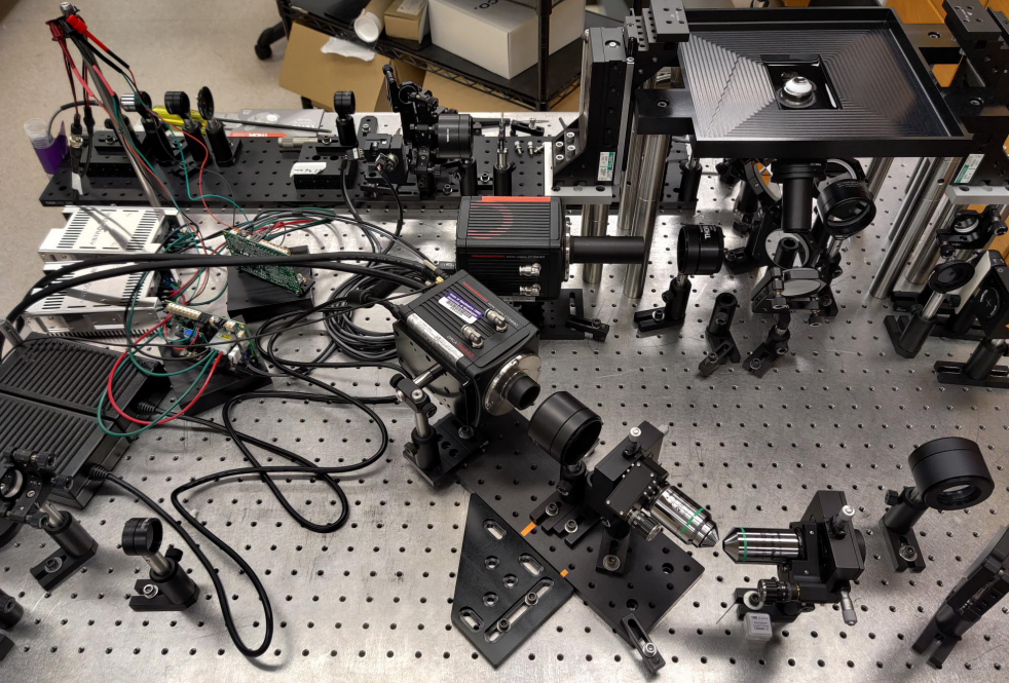
The starting point for all of our work is the ability to render intact tissue optically transparent and to image it at high resolution without ever cutting it into sections. To make this possible, our lab develops and refines tissue clearing and fluorescent labeling protocols that turn dense, opaque kidney specimens — from small biopsies to whole nephrectomy samples — into transparent volumes whose internal architecture can be imaged in full. These workflows are designed to be reversible and non-destructive, preserving precious clinical tissue for downstream molecular assays.
To image these cleared specimens, we build and operate custom open-top light-sheet (OTLS) microscopes. This technology was pioneered by the laboratory of Dr. Jonathan T.C. Liu (Stanford Medicine), whose group established OTLS microscopy as a platform for non-destructive, slide-free 3D pathology of large clinical specimens. The OTLS architecture places all optical components beneath a transparent sample holder, much like a flatbed document scanner, allowing the system to accommodate clinical specimens of essentially any size and shape while imaging large volumes rapidly and at subcellular resolution. Our lab builds directly on this foundational work — and on the broader collaborative effort behind it — to extend OTLS imaging to the unique challenges of the kidney. By constructing these instruments in-house, we can tailor resolution, field of view, and throughput to the specific demands of kidney pathology.
(ii) TubuleMAP: mapping renal tubules
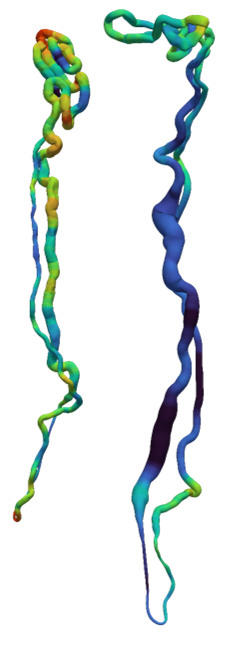
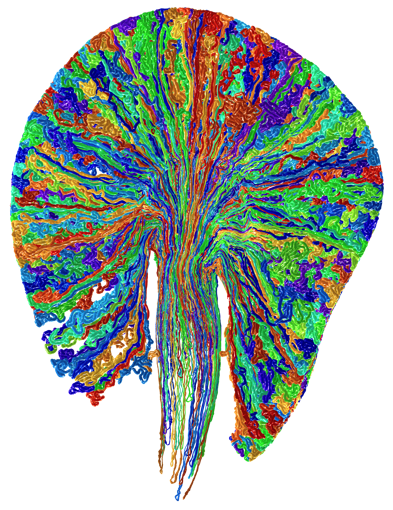
Advances in tissue clearing and lightsheet microscopy now allow us to image intact, convoluted tubular networks at the scale of the whole organ — but the analytical tools needed to make sense of these terabyte-scale datasets have lagged behind. To close this gap, we developed TubuleMAP, a semi-automated pipeline for 3D tubule tracking and reconstruction. TubuleMAP adapts to diverse morphological and staining patterns, leverages parallel processing to handle terabyte-scale image data, and incorporates a napari-based interface that keeps an expert human in the loop for quality control. This work was done in collaboration with the laboratory of Dr. Joshua Vaughan (University of Washington).
Using TubuleMAP, we reconstructed roughly 1,000 intact nephrons from a single ~1-millimeter-thick mouse kidney slab, achieving approximately 400-fold higher throughput with less than 1% of the manual effort required by prior methods. These reconstructions open the door to analyzing mesoscale nephron organization, quantitatively profiling pathologic morphologies, performing whole-nephron cytometry, and identifying rare structural features at scales that were previously inaccessible.
(iii) Building 3D spatial atlases of kidney diseases
Our lab is building detailed 3D reference maps of the kidney using advanced imaging modalities such as open-top light-sheet (OTLS) and two-photon microscopy to achieve subcellular resolution across large tissue volumes. To handle the vast and complex datasets generated by 3D microscopy, we have developed custom AI-driven image analysis pipelines, including tailored deep learning models for automated segmentation and tubule tracking. These tools allow us to map the spatial organization of key kidney structures within intact tissue volumes.
(iv) 3D digital pathology of human kidney biopsies
Our lab aims to advance 3D digital pathology of human kidney biopsies by combining fluorescent analogs of classical histology stains with high-resolution 3D imaging. This approach enables visualization of entire core needle biopsies and nephrectomy samples in their intact, unsectioned state. Using AI-based analysis tools, we assess tissue architecture and pathology in full volumetric context, preserving the native 3D relationships between structures such as tubules, vasculature, and the interstitial compartment.
We are applying this platform to two clinically important disease settings: focal segmental glomerulosclerosis (FSGS) and diabetic kidney disease (DKD). Across both diseases, we aim to demonstrate that 3D digital pathology offers significant advantages over current 2D slide-based histopathology, including:
Increased tissue sampling through full-volume imaging, reducing the risk of missing focal pathology.
True 3D visualization of complex anatomical structures and their spatial relationships.
Reversible, non-destructive workflows that preserve precious tissue for downstream molecular assays.
This direction represents a paradigm shift in renal pathology, offering greater diagnostic depth while maintaining the integrity of irreplaceable clinical samples.